Thursday, May 8, 2014

“Contentment Brings Happiness” (Chinese: 知足常乐; Pinyin: zhīzú cháng lè)


The Sky Over Langfang

April has been fairly uneventful, that is until the very end of the month.  Whereby, I’ve been swamped with activates and visits from friends.  It’s been great.  One misfortune that struck was a bout with the flu.  I got sick around the middle of the month and spent three days curled up in my bed in my apartment.  It wasn’t pretty.  However, I came through to the other side and now I’m feeling much better.  I’m still working on a food blog that describes how to cook my favorite Chinese recipes, but it’s been delayed for at least another week.  Today’s blog is just a retelling of the past two weeks and all the great things that happened.


English Club

I’m the only foreign teacher at NCIAE and it’s my duty to serve the students to the best of my ability.  Unfortunately, I’m limited to what only one man can do.  Another problem is that the school has yet to give me a meeting room for English Club.  Part of my agreement with NCIAE is that I meet with the students at least once a month for English Club.  It’s basically just a meet and greet where the students can have fun and practice their English.  Since I don’t have a meeting room, the English club has relocated to my apartment.  I don’t mind.  I rather enjoy opening up my home to students and their friends.  Although, it is rather limiting as I only have so much room.  But, we make do with what we have.  We will play an assortment of games for English Club.  Sometimes we will play cards games like UNO.  Or we might play Pictionary or gestures.  Other times we might have a singing competition, a dance competition, watch a movie, or just simply talk.  There are no real rules or structure to the meetings.  It’s just a fun place to hangout.  Sometimes we will even cook dinner together.


Italian Style Dinner

About two weeks ago, my freshmen approached me and asked if I could cook Italian style food.  One of my freshmen, Liu Lin, had recently watched a movie where the main character was enjoying some spaghetti.  She then wanted to know if I could cook spaghetti.  I told her that I could and then I invited Liu Lin, and others, to come learn how to cook spaghetti.  Thus English Club transformed for one night into an Italian Style Cooking Club.  The nearby Walmart had all the ingredients I needed and we stocked up to cook three different dishes: spaghetti, salad, and garlic bread.  The recipes are incredibly easy.  For the spaghetti: we boiled the noodles and heated a premade jar of sauce in an open skillet on low heat.  We added sautéed onions to the sauce and let it simmer while stirring constantly.  The salad was fresh cut cucumbers and carrots with premade creamy Caesar dressing.  Lastly, for the garlic bread, we took slices of whole-wheat bread, spread butter over the top and then added a sprinkling of garlic powder and salt.  We then cooked the bread in a toaster oven.  I had a meal for eight done in twenty minutes.  The students loved the cultural experience of being able to try Italian Style food for the first time in their lives.


Dinner with Friends

My students aren’t the only ones who get to enjoy dinners with me.  Recently I’ve made friends with some engineers that work in the north of the city.  We’ve been hanging out more and recently they asked if they could come to my home and cook a Chinese style meal.  I agreed and my friends came over to prepare a real feast.  They cooked: 1) squash and eggs, 2) cold cuts of pork and beef, 3) lotus root salad, 4) cabbage and kale salad, 5) cucumber and garlic salad, 6) fired chicken, 7) cooked beans and pork bits, 8) and rice.  I cooked an American style dish for the crew which was pork, mushrooms and onions in a cream of mushroom sauce.  We ended up cooked far more than we could eat and there were a lot of leftovers.  However, in the Chinese culture it’s a sign of hospitality to have food left over.  I’m never one to let food go to waste so I sent care packages home with my friends.


The Surprise Birthday Dinner

I’m beginning to see that this blog is largely about eating.  It’s no wonder I can’t lose any weight this semester.  The next dinner I want to talk about is the surprise birthday dinner that I was given by two of my students and their friend.  Jia Jia and Cara are two of my freshmen students.  They are fairly shy and quite.  However, they are incredibly kind, very creative, and are incredible cooks.  Jia Jia sent me a message on April 29th saying that she wanted to cook dinner for my birthday.  My birthday wasn’t until the 3rd of May, however, May 1st-3rd is the Chinese Labor day holiday and the students would be traveling home during that time.  So, Jia Jia and Cara wanted to give me a birthday dinner before they left.  They showed up at my apartment with two big bags full of ingredients.  Then the shooed me out of the kitchen and told me not to come back in while they were cooking.  So I made my way into my room and spent the time talking with my brother over Skype.  An hour later, the girls called me into the living room for dinner.  What followed was an amazing surprise.  I can only describe what they cook as a delicious gourmet feast of dishes that had both a delightful taste and beautiful presentation.  I felt like royalty.  I even had a cardboard.  The meal included: 1) White carrot, pork and corn soup, 2) Oysters over starch noodles, 3) Potato, mushroom and chicken stir-fry, 4) Shrimp and Chinese okra, 5) Fish, 6) Squid and peppers, and 7) Birthday cake.  It was wonderful! 


Sports Day

Now for some stories that don’t correspond with food:

This past week was the NCIAE sports day.  NCIAE doesn’t have as big of a sports stadium as Langfang Teacher’s College, so they spread their sports day over a period of days.  Several of my freshmen girls were taking place in a cheer competition and I went to cheer them on.  There were two teams of 40 cheerleaders.  Both teams did a synchronized dance.  They danced to Toni Basil’s song “Hey Mickey.”  It was great.  None of my others students were competing in the competition this year so I ended up leaving after the dance and I didn’t stay for any of the other games. 


Turing 29

This past weekend I turned 29-years-old with mixed emotions.  Sadly, for my mother, her third son has now reached her proclaimed age.  Somehow the aging process stops for most ladies and any smart individual doesn’t ask how.  Personally I’m feeling a sense of maturity accompanied by apathy that’s causing me to regard the words of overly negative critics as entirely inconsequential.  There is, however, one comment I seem to be getting a lot of recently and it seems to be coming from a common source.  Several older ladies and young female students have been asked me about when I’m planning to get married.  One older lady went as far as to even say, “When are you going to fix your life.”  (Fix meaning marriage, naturally.)  This is becoming an increasingly difficult and irritating question to answer.  My first reaction is to say, “None of your business.”  However, this seems fairly rude.  There is also the reality that I don’t even have the prerequisite for marital bliss, i.e. a girlfriend.  I don’t really have an answer for this comment so if anyone has any good ideas for comebacks then please let me know in the comments below.  I do want to point out that these comments don’t come from my good friends.  My good friends have been nothing but nice and they have been treating me very well during this yearly transition.  They took me out to the park, to go on bike rides, and even to play pool.  My life may not be “fixed,” as that one lady has suggested, but it is truly rich indeed.  I have a good life that is full of meaning and purpose in China.  As the old Chinese idiom goes, “Contentment brings happiness” (Chinese: 知足常乐; Pinyin: zhīzú cháng lè).


“Happy Birthday” (Chinese: 生日快乐; Pinyin; shengrì kuàilè)

“How old are you?” (Chinese: 你多大了?; Pinyin: nǐ duōdàle?)

“I am 29-years-old.” (Chinese: 我今年二十九岁; wǒ jīn nián èr shí jiǔ suì)

“Contentment brings happiness” (Chinese: 知足常乐; Pinyin: zhīzú cháng lè).


Saturday, April 12, 2014

A Guide to Shopping in China


Shopping can be a challenge in another culture.  The inability to read labels, currency exchange issues, and understanding proper product values are only a handful of the difficulties that shoppers can expect to face in a foreign country.  However, it’s not impossible to adjust.  I’ve created for you, dear readers, this blog post to educate you on some of the finer points of shopping in China.  

Disclaimer: Shop owners in China don’t like pictures taken of their stalls so this blog post will be a little sparse on photos.  I had only two shopkeepers agree to let me photograph their goods. 

Currency Exchange
“The People’s Currency” (Chinese: 人民币; pinyin: rénmínbì)
“Chinese Dollar” (Chinese: 元; pinyin: yuán) or (Chinese: 块; pinyin: kuài).
“0.1 Fraction of a Yuan” (Chinese: 角; pinyin: jiǎo) or (Chinese: 毛; pinyin: máo)

 
The current market value of the yuan is equal to 0.16 of the US dollar.  This means that 6 yuan is almost equal to 1 American dollar.  Chinese yuan comes in six different notes: 1元, 5元, 10元, 20元, 50元, and 100元.  Sometimes using the 100元 note can be a little intimidating for Americans due to the triple digit figure.  But a good rule of thumb is to think of a Chinese 100元 note like a $20 bill: they are very commonly carried and often exchange hands.  There are also Chinese coins: the 10 cent piece and the 50 cent piece.  This can get a little confusing because the ten cent piece is called the 1 jiao (一角; yījiǎo) and the 50 cent piece is called the 5 mao/jiao (五毛; wǔmáo/五角; wǔjiǎo.)  Most Chinese businesses do not use coins lower than the 0.1’s place.  Furthermore, they do have 1元 coins and 1角 and 5角 notes, so you can expect to see both.  It’s a good idea to take 1元 coins for the Beijing subway systems as these are easily fed into the automatic ticket stalls without too much a hassle.  

Here is an example of some commonly said money exchange dialogue:
Buyer: “多少钱?” (“Duōshǎo qián?” = “How much does it cost?”)
Seller: “十二块五。” (“Shí'èr kuài wǔ.” = “12 yuan and 5 jiao.”)


The literal translation of “十二块五” is actually “10 2 dollar 5.”  The word kuai is a separator used to designate the dollars from the cents.  Shop prices never go beyond the 0.1’s place so you’ll never have a number great than 9 after the word kuai.  However, coins a very seldom used.  Most stores sell things in dollar amounts only.  So it’s common to see a smart phone tagged with a priced of 2499元 and a pair of pants tagged at a price or 300元.  Food stores are the only place where such labels as 3.5元 are common. 


Where to Shop for Food

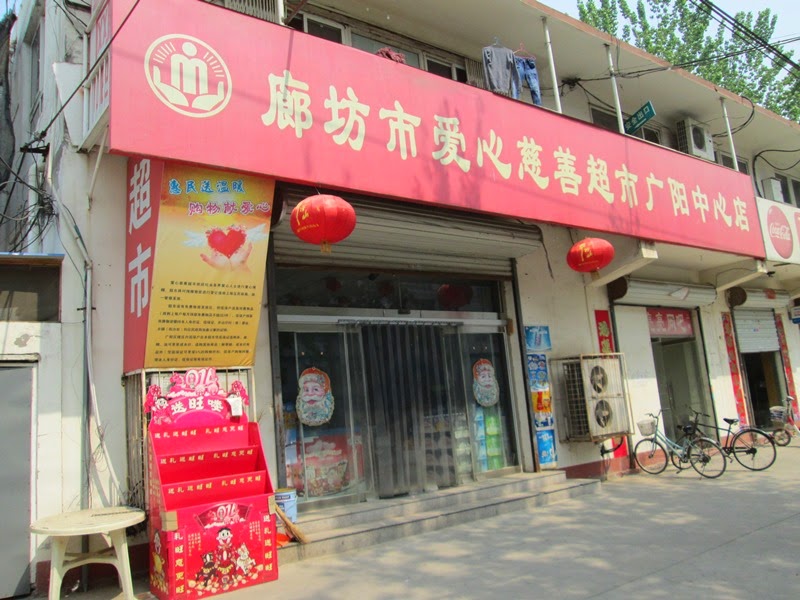
There are several convenient shopping locations located within walking distance of my apartment.  There is a lady who sells fruit on the corner of my block, a couple convenience stores, and a Walmart Supercenter that’s only a 10 minute walk from my place.  For me, I can get almost everything I need from these three stores.  The local convince store is a little more expensive than Walmart but it’s really easy to get to and it beats waiting in the long checkout lines.  However, it has a limited supplies and I’m often left with a once a week Walmart run for the real food.  Walmart, on the other hand, is a two-story tall building full of almost everything you could need, with the exception of cheese and butter.  (It’s really hard to find cheese and butter in China.)  Walmart has a fresh produce section, a meat counter, and plenty of isles of goods.  The have one whole isle dedicated to foreign imports.  Here you can find such exotic goods as Goldfish Crackers, cans of Campbell’s Cream of Mushroom soup, and ketchup!  The setup and layout of Walmart is distinctly American and it is probably the one place an American would feel at home when shopping.  Nevertheless, there are a couple of differences for Chinese convenience.  You’ll find that all the products have Chinese labels and seldom come with English.  Also, they don’t refrigerate their eggs... That takes a little getting used to.  Other differences include: milk in a bag, butchers cutting up dead pigs right before your eyes, and a counter where you have to get your selection of fresh vegetables weighed and sealed due to theft concerns.  Labels can be a real issue due to the lack of package images and English.  I recommend an interpreter for a first visit or to buy a known product.  Certain products still bare the same English logos like Tide and Gillette.  But there are also many Chinese brands to consider and some might be better.  However, I don’t recommend Mr. Bright potpourri flavored tooth paste.  It not only tastes bad but it made my lips go numb.  Don’t worry, I switched brands and I once again have full use of my lips. 

Buying Goods
Buying fruit, vegetables, and grains are a whole other issue.  I normally visit the fruit lady and her cart to buy all my bananas, oranges, strawberries and pineapples.  But buying fruit from her requires knowing the terms regarding amount and weight of the fruit you want to buy.  China uses the metric system and they have their own words for weight measurement.  The most important word is jin (Chinese 斤; pinyin: jīn).  1 jin is equal to 1.102 lb and 2 jin is equal to 1 kilogram.  When buying fruit, the seller will ask you how many jin do you want and they will often tell you the price of the fruit per jin.  The only exception to this is bananas and they’ll just ask you how many you want.

Example:
Buyer: “草莓多少钱一斤?”  (“Cǎoméi duōshǎo qián yī jīn?” = “How much for 1 pound of strawberries?”)
Seller: “四块钱一斤。” (“Sì kuài qián yī jīn.” = Four yuan a pound.”

Note how the buyer’s sentence is constructed:
草莓 (cǎoméi = Strawberries)
+ 多少钱 (duōshǎo qián = How much?)
+ 一斤 (yī jīn = one pound).
So a literal translation is “Strawberries, how much for one pound?” 
If you want half-a-pound then simply say ban jin (半斤; bàn jīn) instead of yi jin (一斤; yī jīn).  Yi simply means one and ban simply means half.  Replace the word yi with any of the other numbers if you want more than one pound. 

Chinese Number System
一,二,三,四,五,六,七,八,九,十
yī, èr, sān, sì, wǔ, liù, qī, bā, jiǔ, shí

one, two, three, four, five, six, seven, eight, nine, ten

Numbers between ten and twenty are written/spoken:
十一 (shí yī = 11), 十二 (shí èr= 12), etc.
Anything more than 19 is written/spoken:
二十 (èr shí = 20), 二十一 (èr shí yī = 21) , etc.


“Hundred” (Chinese: 百; pinyin: bǎi )

The most common store labels will use Arabic numerals: ¥ 9.50 元.  However, some street merchants will label their goods with Chinese numbers: 三元/斤 (“sān yuán/jīn” = “3 yuan for each pound”). All merchants will speak the Chinese names of the numbers regardless of the label.


Haggling with Street Vendors

Do you feel overwhelmed yet?  There’s one more area I want to tackle.  That’s the area of bargaining and product value.  One feature of most Chinese merchants is that they will spend hours haggling over prices.  Department stores won’t do this but there are lots of street merchants and most all are willing to make a deal.  However, some caution is advised.  Goods sold by street merchants are most likely knock-off products and they come in abundance.  If you want to know the true value of a legitimate product than department stores like Walmart are your best bet.  Get to know the prices of things you want to buy by looking at the tags.  A dress shirt probably costs somewhere between 100元-130元 ($16-$20).  So some prices are comparable to the US market.  Food prices are often 3-6 times less than their American counterparts.  It’s not advisable to barter with street merchants when it comes to food.  They usually price things fairly and won’t charge you above the market value.  Clothing merchants, on the other hand, will rob you blind if you let them.  

Near my apartment is a park called the Children’s Park.  It has long since ceased to function as a children’s amusement park and is now overrun with merchant stalls.  There are a lot of odds and ends that can be found in this place.  Some items are secondhand and others are knock-offs.  I went there last winter hoping to find a cheap winter coat.  A salesman pulled me into his booth and showed me his fine line of Jack Wolfskin jackets.  Upon closer inspection of the tag I found that there were spelling errors, (a sure sign of a knock-off product).  The salesman tried to convince me that it was legit and then he said in broken English, “You are my friend and I will give you a good deal.”
I asked him how much and he said, “For you, my friend, 600元.”  (600元 = $100)
I took one disgusted look at him, threw my hand in the air and angrily proclaimed, “太贵了!” (tài guile = too expensive.)  Then I walked away with the shop keeper on my heels begging me to name my price.

Street merchants will try to milk foreigners for everything they can get.  Usually they will charge an excess of 8-10 times higher than the actual value of the product.  When buying from street merchants I have a method that usually gets them down.  When buying such things as Chinese shirts or other goods I will always pretend to be dumb.  I pretend that I can’t speak Chinese and that I’m happy with their sells pitch.  Most all of them will always give a long speech about how the product is so good and how they are willing to sacrifice to make the deal work for you, “Their new friend.”  I always let them finish their speech before saying anything, all-the-while, acting very pleased with what I’m hearing.  Once the speech is over then they will give the price.  It’s at this point that I take one disgusted look at them, throw up my hand in the air and angrily proclaimed, “太贵了!” (tài guile = too expensive.)  It’s usually upon realizing I can speak in Chinese that the merchants start quickly backpedaling.  At this point I will direct their attention to the price values of department stores and say that their product isn’t even worthy enough to get inside Walmart.  This is when the price value war begins.  One time, I was buying a Chinese shirt, when the buyer started out with an asking price of 600元.  I responded with 50元.  He was insulted by how low I went and said he wouldn’t sell me the product.  So I turned a left his store.  He immediately followed me out, grabbed my hand, pulled me back in and apologized.  He then dropped it to 500元.  I went up to 60元.  This continued until we finally settled on 80元.  It might seem like a hassle to go through all this trouble of bargaining but I find it fun to watch street merchants squirm.  I good rule of thumb is to always be willing to walk away if you don't get the price you want.  More than likely there will be another merchant selling the same thing just a stall away.

Shopping in China can be an adventure.  But it’s one that I believe every foreigner can handle.  Don’t be afraid to ask for help.  Most people are very willing to help out a dazed and confused foreigner.  Just don’t ask the street merchants for help and never believe them when they say they are your friend.  If you want straight forward shopping than I recommend Walmart and other large department stores. 


Bulk goods and unrefrigerated milk.

For your cold drinks.

Everything a Chinese kitchen could need.

Instant Noddles!

Sauces for Cooking

MSG in a Bag!

Recognize these?

How about those flavors?

"Yum, stake flavored potato chips!"

Does America even sell bars of soup for cleaning clothes?

Need some paper?

Snacks!

Warm Drinks

My Local Convenience Store

Goods from Walmart

Sealed Vegetables from Walmart & Bagged fruit from the Fruit Lady

Walmart!

Street Vendors Outside of Walmart

Walmart Prices

"The incredible, edible, and unrefrigerated egg!"

Fruits and Vegetables

Bread

The Fruit Lady!